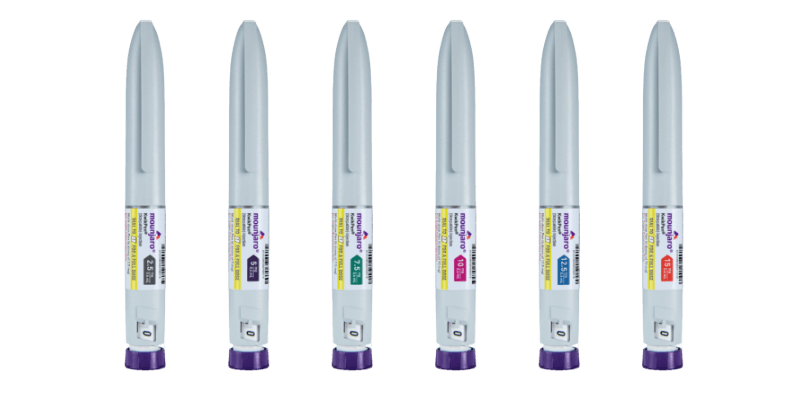
No, the leftover liquid in a Mounjaro KwikPen after your fourth injection is not a safe fifth dose, and you should not attempt to inject it.
The remaining liquid is an intentional engineering feature called overfill, designed to ensure each of your four prescribed doses is delivered accurately. It is not a measured, usable dose.
We explain exactly what the golden dose is, why the overfill exists, the risks of attempting to use it, and what has changed with the new 2026 Mounjaro KwikPen redesign.
What is the Golden Dose?
| Pen detail | Measurement |
| Total liquid in the KwikPen | 3 ml |
| Volume per prescribed dose | 0.6 ml |
| 4 doses total (deliverable volume) | 2.4 ml |
| Remaining after 4th dose (approximate) | 0.3–0.6 ml (overfill + priming volume) |
The 0.3 – 0.6 ml of remaining liquid is not a measured fifth dose of your prescribed strength. It is the combined overfill and priming liquid built into the device by Eli Lilly to guarantee accuracy of your four prescribed doses.
The pen cannot mechanically dial or dispense a fifth full dose after the fourth has been administered.
Why Overfill Exists
Why every injectable pen includes overfill
Overfill in pre-filled injectable pens is a standard pharmaceutical engineering requirement, not specific to Mounjaro. It exists for three reasons:
- Flow checks (priming): Before each injection, a small amount of liquid is released from the needle tip to remove air bubbles and confirm the pen is working correctly. This priming step uses a small amount of the overfill.
- Manufacturing tolerances: Small variations in cartridge filling across thousands of pens mean a buffer is needed to ensure every patient receives the correct dose.
- Ensuring complete delivery of the 4th dose: The last dose must be fully delivered, which requires liquid behind it. Without overfill, the final dose might be incomplete.
In plain terms: the leftover liquid is the cost of accuracy. Without it your doses would be unreliable. Eli Lilly did not design the pen to provide five doses; the residual liquid is what makes it possible to have four correct doses.
Risks
Sterility and infection
Once a Mounjaro KwikPen is first used, it must be disposed of within 30 days, regardless of how much liquid appears to remain. After this point, the sterility of the remaining liquid is no longer guaranteed by the manufacturer.
Your pen is not designed to be used beyond week 4. If you attempt to extract liquid in week 5 or beyond:
- The preservative in the pen cannot maintain sterility after the pen has been opened and used
- Bacteria can enter via the used needle port or through improper handling
- Injecting contaminated liquid under the skin can cause infection at the injection site, and in severe cases Sepsis
This is particularly important if you are using a syringe or extraction tool to access the residual liquid, as these actions break the pen’s sealed mechanism entirely, immediately ending any sterility guarantee.
Why is the golden dose a trend?
The golden dose trend spread primarily through TikTok, Reddit, and weight loss communities online driven by two factors: the high cost of Mounjaro in the UK and the visible liquid that remains in the pen after the fourth injection.
When patients who are paying privately for their treatment see what looks like usable medication left in the pen, it naturally feels wasteful. The term “golden dose” itself was coined to describe what looked like a free, bonus injection.
Online communities began sharing methods for extracting this liquid using insulin syringes, with many users reporting they had done so without apparent immediate harm.
This is understandable but it doesn’t make it safe. The absence of an immediate reaction doesn’t confirm a dose was administered correctly, nor does it confirm the liquid was sterile. The risks are real even when they don’t manifest immediately.
A note on extraction kits: There has been a rise in unregulated “conversion kits” sold online that claim to help extract the golden dose. These are not sterile medical devices, are not regulated by the MHRA, and introduce significant additional contamination risk on top of the dosing inaccuracy problem. Do not use them.
The new Mounjaro pen: what’s changed in 2026
From April 2026, Eli Lilly began rolling out a redesigned Mounjaro KwikPen across UK pharmacies. The new pen has been modified specifically to reduce the amount of residual liquid remaining after the fourth dose — effectively eliminating the golden dose.
| Feature | Original KwikPen | New KwikPen (2026) |
| Golden dose visible | Yes — visible liquid after 4th dose | No — plunger sits close to end |
| Dosing mechanism | Same | Same — unchanged |
| Active ingredient | Tirzepatide | Tirzepatide — unchanged |
| Number of prescribed doses | 4 | 4 — unchanged |
| How you use it | Same as before | Same as before |
Crucially: the medicine itself, the dosing schedule, and how you use the pen are completely unchanged.
Only the internal mechanism has been updated to reduce the visible overfill. Your treatment is unaffected.
If you receive the new pen, you may notice it looks slightly different and that there is less visible liquid after your fourth injection. This is normal and expected. Your prescription and dose remain the same.
Note: Both the original and new KwikPens will be in circulation simultaneously for a period while the rollout completes. If you are unsure which version you have, check with your pharmacist at The Family Chemist.
The Mounjaro dosing schedule
Mounjaro is prescribed as a step-up programme, starting at a low dose to minimise side effects and increasing every 4 weeks as tolerated.
Each dose level has a dedicated pen. When you finish one pen after 4 doses, you begin the next pen at the same or next strength, as directed by your prescriber.
| Dose | Duration | Move to next level when… |
| 2.5 mg | Weeks 1–4 (starting dose) | After 4 doses, move to 5 mg |
| 5 mg | Weeks 5–8 | After 4 doses; if tolerating well |
| 7.5 mg | Weeks 9–12 | After 4 doses; if tolerating well |
| 10 mg | Weeks 13–16 | After 4 doses; if tolerating well |
| 12.5 mg | Weeks 17–20 | After 4 doses; under prescriber guidance |
| 15 mg (max) | Week 21 onwards | Under prescriber guidance |
This gradual increase exists because rushing to a higher dose significantly increases the risk of side effects (nausea, vomiting, diarrhoea).
Injecting an unknown amount from the golden dose disrupts this carefully managed schedule, which is one of the reasons it is strongly discouraged beyond the dosing accuracy issue alone. As this is unsafe and against guidelines, the ‘5th dose’ will not be recognised as an actual dose and may flag a gap in your treatment instead.
If cost is why you’re considering the golden dose
The cost of Mounjaro in the UK is a genuine challenge for many patients. The golden dose trend exists because people are looking for ways to manage that cost. The answer is not to stretch your pen but there are options:
- Review your current dose: If you are on a higher dose than you need to maintain results, your prescriber may be able to step you down to a lower and cheaper maintenance dose. Speak to a clinician at The Family Chemist about whether your dose is still appropriate.
- Check for prescription reviews: A clinician can assess whether you are on the right dose for your weight and progress. Being on a lower dose is not a failure of the treatment it may simply mean the treatment is working well.
- Explore alternative GLP-1 treatments: Liraglutide and Wegovy (semaglutide) may be available at different price points. The Family Chemist can help you compare options.
The Family Chemist offers GPhC-registered prescribing support for all Mounjaro patients, including dose reviews and cost discussions. Speak to our team before making any changes to your treatment.
How to dispose of your Mounjaro pen safely
After your fourth injection or after 30 days from first use, whichever comes first you must dispose of your Mounjaro KwikPen safely. Even if visible liquid remains, the pen should be discarded at this point.
- Always remove the needle from the pen before disposal
- Needles must go into an approved sharps disposal container – not household waste
- If your sharps container is full, contact your local council or pharmacy for collection
The Family Chemist does not include a sharps bin with your Mounjaro prescription for safe needle disposal you will need to purchase one.