





Dutasteride 0.5mg is a once-daily, prescription-only treatment that can be prescribed off-label for male pattern hair loss. It works by reducing the hormone (DHT) that shrinks hair follicles.
- Taken once a day
- Clinically proven to increase hair growth
- Contains 0.5mg dutasteride
Please note this medication contains gelatin
Pricing
| 0.5 mg | |
| 30 Capsules | £14.99 |
| 90 Capsules | £43.99 |
| 180 Capsules | £88.99 |
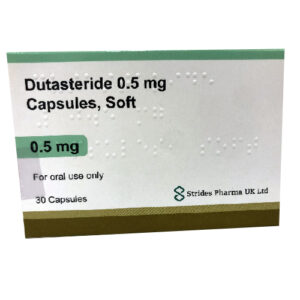
NOTE: Brands and packaging may differ from picture.
When starting the consultation you will be redirected to the treatments page where you can start the short questionnaire.

Same day dispatch if ordered before 2pm

Discreet and plain packaging

Free expert support & advice

GPhC Registered

Free Delivery (Orders Over £20)

Confidential & Discreet
Buy Dutasteride
How to order Dutasteride online:
- Complete a short online consultation to see if you’re eligible for treatment
- Reviewed by one of our clinicians
- If approved, we post it to you discreetly and with tracked delivery
What is Dutasteride?
Dutasteride 0.5mg capsules are a 5-alpha-reductase inhibitor that lowers levels of dihydrotestosterone (DHT), the hormone that drives male pattern hair loss. It is sold under the brand name Avodart and also as a generic.
How does Dutasteride work?
Dutasteride stops testosterone converting into dihydrotestosterone (DHT), it reduces DHT by around 90%.
DHT is a male hormone that gradually shrinks hair follicles so that hairs grow back thinner and shorter until they stop appearing on the scalp. By blocking DHT, dutasteride slows down hair loss and gives the hair follicles a chance to recover and regrow into thicker, healthier hair.
Dutasteride is a dual action inhibitor this means it blocks type I and type II of the enzyme that convert testosterone into DHT, which makes it very effective compared to other hair loss treatments that only block type I of the enzyme.
How to take Dutasteride
Take one 0.5mg capsule once daily, with or without food, ideally at the same time each day for consistency.
Swallow the capsule whole – do not chew, crush or open it, as the contents can irritate the mouth and throat.
If you miss a dose, don’t double up; simply take your next dose at the usual time. Consistency is key as the benefits are gradually lost if you stop taking the treatment.
Who can use Dutasteride for hair loss?
Dutasteride is suitable for adult men with male pattern hair loss, particularly those who have seen limited benefit from treatments like finasteride.
If dutasteride isn’t right for you, our clinicians can suggest alternatives.
Complete a short online assessment that is reviewed by our clinicians to check if you’re suitable for this treatment.
The online assessment only takes a few minutes, and is reviewed by our clinicians who will confirm what’s suitable for you.
Who cannot use Dutasteride
Dutasteride for hair loss treatment should not be used if any of the following apply:
- Women, and women who are pregnant or may become pregnant.
- Known allergy to dutasteride or to soya/peanut – some capsules contain soya lecithin, so check the leaflet for your supplied product.
- Severe liver problems.
Speak to a clinician:
- Men trying to conceive – dutasteride can affect fertility and semen
- Severe bladder or urinary conditions
- You take other medicines that may interact with dutasteride
Dutasteride side effects
Most men tolerate dutasteride well, but side effects do occur. The most reported side effects are sexual:
- Reduced libido
- Erectile difficulties
- Changes in ejaculation
- Tender breast tissue (gynaecomastia)
These are often mild and may ease over time. In a small number of men, some sexual side effects have been reported to continue after stopping treatment. Always report breast lumps, pain, enlargement or nipple discharge to a clinician promptly.
Dutasteride and mental health
In May 2026, the MHRA strengthened its safety guidance for finasteride and dutasteride. As a precaution, dutasteride’s product information is being updated to note that mood alterations including low mood and depression have been reported with finasteride, a medicine in the same class.
If you experience low mood, depression, or any thoughts of self-harm while taking dutasteride, contact your prescriber or a healthcare professional as soon as possible.
If you need urgent support: contact the Samaritans free on 116 123 at any time, call NHS 111 for urgent advice, or call 999 in an emergency.
Dutasteride can also lower PSA (prostate-specific antigen) blood-test levels by about half; if you have a PSA test, tell your doctor you take dutasteride so the result can be interpreted correctly.
You can report any suspected side effect through the MHRA Yellow Card Scheme. Always read the patient information leaflet supplied with your medicine.
Does Dutasteride work for hair loss?
Yes, studies support the effectiveness of Dutasteride 0.5mg for male pattern hair loss.
In a randomised clinical trial, men taking Dutasteride 0.5mg daily for 6 months experienced an average 8.2% increase in hair count around the scalp, compared to a 3.3% increase in those taking a placebo.
In a 5-year study, 89.9% of men who continued taking Dutasteride 0.5mg showed a visible improvement in their hair, while 93.9% either showed improvement or experienced no further progression of their hair loss.
Dutasteride vs Finasteride: comparison
Dutasteride and finasteride are both 5-alpha-reductase inhibitors that lower DHT, but they aren’t identical. The key difference is that dutasteride blocks both Type I and Type II enzymes, finasteride blocks only Type II.
This means that Dutasteride is more effective at reducing DHT by around 90% compared to Finasteride which reduces DHT by about 70%. The table below summarises how they compare.
| Feature | Finasteride | Dutasteride |
|---|---|---|
| Medicine class | 5-alpha-reductase inhibitor (Type II only) | Dual 5-alpha-reductase inhibitor (Type I and Type II) |
| Licensed UK use | Male pattern hair loss (1mg) and BPH (5mg) | Benign prostatic hyperplasia (0.5mg). Hair loss use is OFF-LABEL |
| Dose for hair loss | 1mg once daily | 0.5mg once daily (off-label) |
| DHT reduction | ~70% | ~90% |
| Typical time to results | 3–6 months | 3–6 months |
| Common side effects | Reduced libido, erectile difficulties, ejaculation changes, mood changes | Similar profile; effects may last longer due to longer half-life |
| Half-life | 5–6 hours | Approx. 3–5 weeks |
| Prescription status | Prescription-only (POM) | Prescription-only (POM) |
Because finasteride carries a hair-loss licence, it is usually the first-line choice. Dutasteride may be considered off-label when finasteride hasn’t delivered enough benefit or wasn’t tolerated. The right option depends on your history and goals — which is exactly what the consultation is designed to establish
How long does Dutasteride take to work?
Most men start to see results within the 3 to 6 months of consistent use, but it can take up to a year to see the full benefits of Dutasteride.
Here is a simple guide of what to expect:
- 1–3 months: no visible change; some men see a temporary increase in shedding as the follicles reset, this is normal.
- 3–6 months: shedding usually slows and hair loss stabilises.
- 6–12 months: visible thickening and regrowth become more apparent, mainly at the crown and mid-scalp.
- 12+ months: maximum benefit, which can continue improving for up to two years with continued use.
In the early months it may feel like maintenance rather than growth which is expected. If you stop treatment, DHT returns and hair loss typically resumes within 6 to 12 months.
How to take Dutasteride
Take one 0.5mg capsule once daily, with or without food, ideally at the same time each day for consistency. Swallow the capsule whole – do not chew, crush or open it, as contact with the contents can irritate the mouth and throat.
If you miss a dose, don’t double up; simply take your next dose at the usual time. Consistency is key: the benefits are gradually lost if treatment stops.
Who cannot use Dutasteride
Dutasteride isn’t appropriate for everyone, and your consultation will confirm suitability. It should not be used if any of the following apply:
- Women, and anyone who is pregnant or may become pregnant – including handling the capsules, as dutasteride can be absorbed through the skin and may harm a male foetus.
- Known allergy to dutasteride or to soya/peanut – some capsules contain soya lecithin, so check the leaflet for your supplied product.
- Severe liver problems.
- Severe bladder or urinary conditions (discuss with a clinician).
- Men trying to conceive – dutasteride can affect fertility and semen; discuss with your clinician first.
You should also not donate blood while taking dutasteride and for 6 months after your last dose, to avoid a pregnant recipient being exposed to the medicine.
Dutasteride side effects
Most men tolerate dutasteride well, but side effects do occur. The most commonly reported are sexual:
- Reduced libido
- Erectile difficulties
- Changes in ejaculation
- Tender breast tissue (gynaecomastia)
These are often mild and may ease over time. In a small number of men, some sexual side effects have been reported to continue after stopping treatment. Always report breast lumps, pain, enlargement or nipple discharge to a clinician promptly.
Dutasteride and mental health
In May 2026, the MHRA strengthened its safety guidance for finasteride and dutasteride. As a precaution, dutasteride’s product information is being updated to note that mood alterations — including low mood and depression — have been reported with finasteride, a medicine in the same class. If you experience low mood, depression, or any thoughts of self-harm while taking dutasteride, stop and contact your prescriber or a healthcare professional as soon as possible.
If you need urgent support: contact the Samaritans free on 116 123 at any time, call NHS 111 for urgent advice, or call 999 in an emergency.
You can report any suspected side effect through the MHRA Yellow Card Scheme. Always read the patient information leaflet supplied with your medicine.
Alternatives to Dutasteride
If dutasteride 0.5mg is suitable for you or you’d prefer a different treatment, there are other effective treatments available:
- Finasteride 1mg — the only oral treatment licensed in the UK for male pattern hair loss; blocks Type II 5-alpha-reductase.
- Minoxidil topical solution (Regaine) — applied directly to the scalp to stimulate growth; available over the counter.
- Oral Minoxidil — a low-dose daily tablet, by prescription.
- Hair Loss Dual Action — combination products that pair a DHT blocker with minoxidil for a two-pronged approach.
Dutasteride FAQs
Is dutasteride stronger than finasteride?
In terms of DHT reduction, yes. Dutasteride blocks both Type I and Type II 5-alpha-reductase and lowers DHT by around 90%, compared with around 70% for finasteride, which blocks only Type II.
What is the difference between dutasteride and Avodart?
They are the same medicine. Avodart is the original brand name for dutasteride 0.5mg; generic dutasteride contains the identical active ingredient at the same strength and is usually more affordable.
Can dutasteride be used alongside minoxidil?
Yes, Dutasteride reduces DHT internally while minoxidil stimulates growth at the scalp, so they’re often combined for better results. Discuss this with a prescriber before combining treatments.
What happens if I stop taking dutasteride?
The effect only lasts while you take it. If you stop, DHT levels return, and any hair you’ve maintained or regrown is generally lost within 6 to 12 months. Dutasteride is a long-term treatment.
Does dutasteride affect PSA test results?
Yes. Dutasteride lowers PSA blood levels by roughly half after several months. If you’re having a PSA test, tell your doctor you take dutasteride so they can interpret the result correctly.
Can women take dutasteride?
No. Dutasteride must not be used or handled by women, especially during pregnancy, because it can harm the development of a male baby. Women experiencing hair loss should seek advice tailored to them.
Why might I shed more hair when I first start?
A temporary increase in shedding in the first 2–3 months can happen as follicles move into a new growth cycle. It usually settles — keep taking the medicine as prescribed and speak to your clinician if you’re concerned.
When is the best time of day to take dutasteride?
Any time that’s convenient — morning or night. The key is taking it at the same time each day to keep levels steady.
More Treatments Available
Read more about Men's Health

How It
Works?
1. Consultation
Fill out a quick, free online questionnaire for the condition you may have .
2. Treatment
Choose your preferred treatment and proceed to checkout.
3. Assessment
Our clinicians review your information and may follow up if needed.
4. Delivery
Your medication is approved and delivered quickly in discreet packaging.
1. Consultation
Fill out a quick, free online questionnaire for the condition you may have.
2. Treatment
Choose your preferred treatment and proceed to checkout.
3. Assessment
Our clinicians review your information and may follow up if needed.
4. Delivery
Your medication is approved and delivered quickly in discreet packaging.
How to
How It Works
Join our newsletter
Sign up to enjoy regular updates, exclusive promotions, and special offers, plus 15% off your first order.
Regulated care you can trust
MHRA-approved and GPhC regulated; we strive to provide the highest standards of care.
General Pharmaceutical Council
General Pharmaceutical Council
The GPhC is the regulator that inspects pharmacies to make sure they meet the highest standards, keeping your safety their top priority.
National Pharmacy Association
The NPA represents independent pharmacies across the UK, offering advice, support, and providing our professional indemnity cover.
Medicines & Healthcare products Regulatory Agency
The MHRA makes sure medicines and medical devices are safe and effective. They approve licenses and monitor safety through the Yellow Card scheme. All our products are MHRA approved.
Digital Clinical Excellence
DiCE is a UK network that works to improve safety and quality in digital healthcare.
How it
works?
1. Consultation
Fill out a quick, free online questionnaire for the condition you may have.
2. Treatment
Choose your preferred treatment and proceed to checkout.
3. Assessment
Our clinicians review your information and may follow up if needed.
4. Delivery
Your medication is approved and delivered quickly in discreet packaging.
Meet our medical professionals
Our clinicians are experts in medicines, nutrition, patient care, and governance.









Aaliyah Nelson
Nutritionist